One of America’s Most Destructive Hurricanes.
When people think about the most destructive hurricanes in American history, names such as Katrina, Andrew, Camille, Harvey and the Great Galveston Hurricane immediately come to mind. Each of these storms represents a different kind of hurricane disaster: some were extraordinarily powerful, some produced catastrophic storm surge, some caused unprecedented economic losses, and others became deadly because of flooding.
Hurricane Helene, which struck the United States in September 2024, deserves a place among them.
Helene was not the strongest hurricane ever to make landfall in the United States, nor was it the deadliest hurricane in American history. But it demonstrated something particularly dangerous about modern hurricanes: a storm does not have to remain a powerful hurricane to cause catastrophic destruction far inland.
Hurricane Helene made landfall in Florida’s Big Bend region as a Category 4 hurricane on September 26, 2024. It then moved rapidly inland, carrying enormous amounts of moisture into Georgia, South Carolina, North Carolina, Tennessee and neighboring areas. The result was a disaster involving storm surge, extreme winds, flash flooding, river flooding, landslides, infrastructure failures and prolonged power outages.
According to the National Hurricane Center’s later assessment, Helene was responsible for at least 250 deaths in the United States, including at least 175 direct deaths. That made it the deadliest hurricane to strike the contiguous United States since Hurricane Katrina in 2005.
Its estimated U.S. cost reached approximately $78.7 billion, making Helene the seventh-costliest tropical cyclone to affect the United States in NOAA’s inflation-adjusted historical record.
The Birth of Hurricane Helene
Hurricane Helene developed in the Atlantic in September 2024 during an active hurricane season.
As the system approached the southeastern United States, conditions in the Gulf of Mexico were highly favorable for strengthening. Helene intensified rapidly and became a major hurricane before reaching Florida.
On September 26, Helene came ashore near Florida’s Big Bend as a Category 4 hurricane. The National Hurricane Center’s final report describes the storm as producing a combination of catastrophic inland flooding, extreme winds, deadly storm surge and numerous tornadoes across the southeastern United States and southern Appalachians. But the Florida landfall was only the beginning.
Helene’s Most Unusual Threat: The Mountains
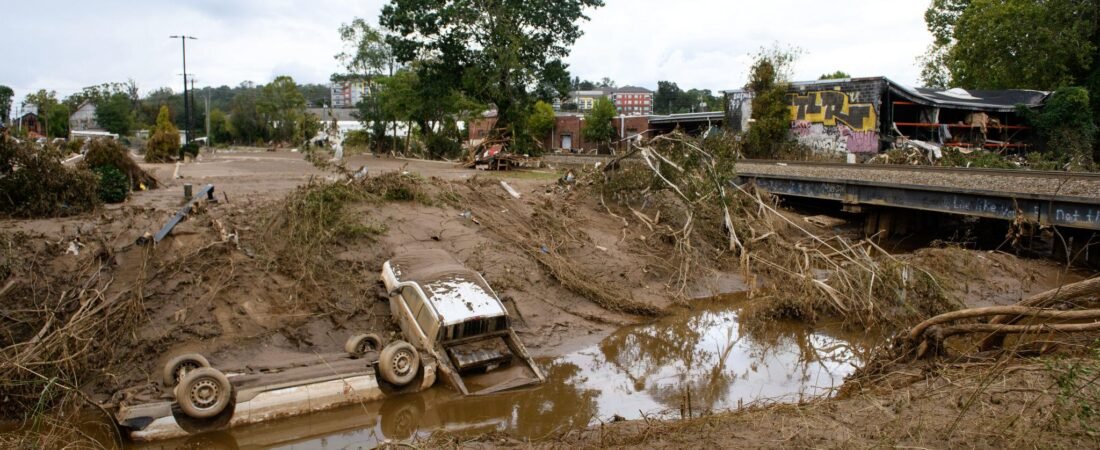
One of the most important things about Helene was what happened after it left the coast. Hurricanes are often associated with coastal communities because of their storm surge and destructive winds. Helene demonstrated how dangerous a hurricane can remain after moving hundreds of miles inland. The storm pushed enormous quantities of tropical moisture into the Appalachian region.
Parts of the Southeast received extraordinary amounts of rainfall. The U.S. Geological Survey reported that some areas experienced more than 30 inches of rain, while its later analysis identified a maximum cumulative rainfall of approximately 848 millimeters (33.4 inches) across the affected region.
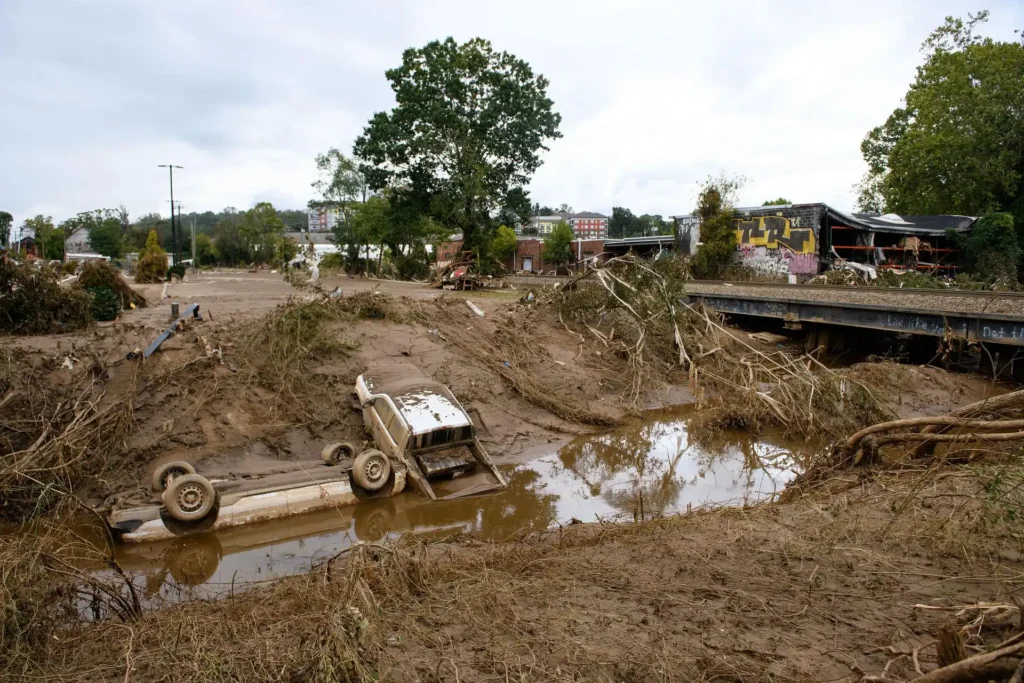
The mountainous terrain made the situation even worse. Rain fell onto already saturated ground. Rivers rose rapidly. Roads disappeared beneath floodwaters. Bridges were destroyed. Hillsides collapsed.
And then came the landslides.
The USGS eventually mapped 2,217 landslides associated with the Helene event and preceding rainfall, with about 55% damaging infrastructure or property.
Western North Carolina was particularly devastated. In Buncombe County alone, 43 people died. In Fairview, a series of landslides converged into a destructive channel, with mudflows traveling more than a mile and killing 13 people.
This was one of the defining characteristics of Helene: its greatest destruction was not limited to the coastline.
The Destruction Across the Southeast
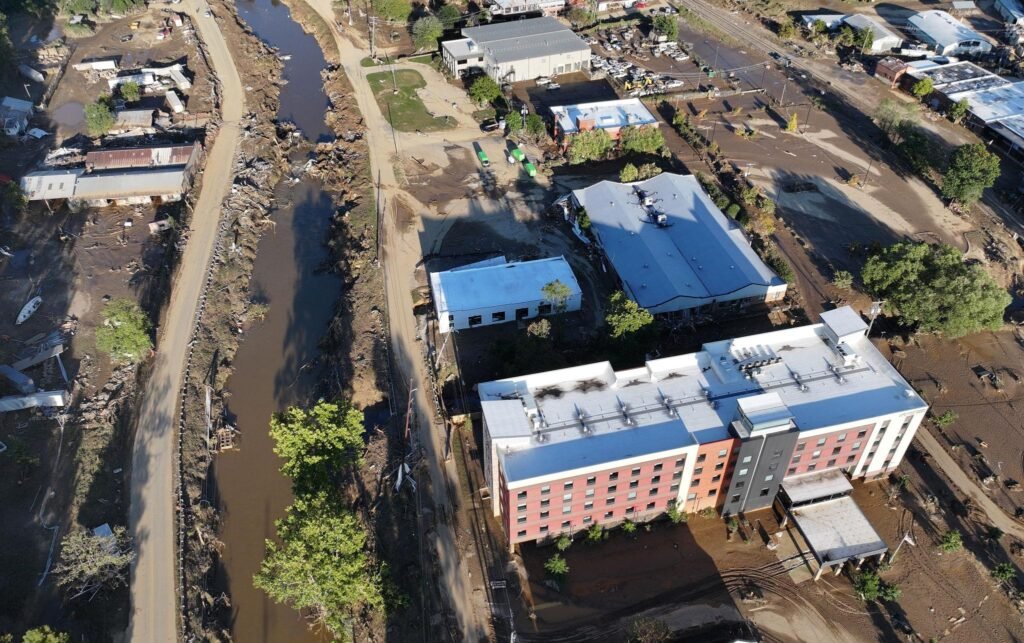
Helene affected a vast geographical area. Florida experienced the initial hurricane landfall, including dangerous storm surge and destructive winds. Georgia experienced powerful winds, flooding and widespread power outages. South Carolina and North Carolina experienced extensive flooding and landslides.
The Appalachian region was particularly vulnerable because of its steep terrain and narrow river valleys.
Communities that were not traditionally viewed as major hurricane targets suddenly faced conditions resembling a catastrophic flood disaster.
The USGS reported that several stream gauges recorded extreme or historic water levels, with at least 34 flood records set during the storm.
The consequences extended far beyond individual homes.
Roads and bridges were destroyed. Electrical networks failed. Telecommunications were disrupted. Water systems were damaged. Some communities became temporarily isolated because roads connecting them to the outside world were destroyed.
NOAA reported that many people in the affected region were without electricity or running water for extended periods, in some cases for more than a month.
How Helene Compares With Hurricane Katrina
If there is one hurricane that provides the most useful comparison with Helene, it is Hurricane Katrina.
Katrina struck the Gulf Coast in August 2005 and became one of the most devastating natural disasters in American history.
Katrina was responsible for approximately 1,833 fatalities and around $108 billion in damage in 2005 dollars. NOAA continues to classify it as the costliest disaster to affect the United States.
However, the two storms were destructive in very different ways.
Katrina’s greatest weapon: storm surge and coastal flooding
Katrina’s destruction was concentrated heavily along the Gulf Coast, particularly Louisiana and Mississippi. New Orleans became the symbol of the disaster after failures of the city’s flood-protection system contributed to catastrophic flooding.
Helene’s greatest weapon: water moving inland
Helene’s destruction was more geographically dispersed.
Instead of concentrating almost all of its catastrophic consequences around one major coastal metropolitan area, Helene carried enormous quantities of moisture deep into the Southeast.
Flooding, rivers and landslides became major killers.
This distinction is important.
Katrina demonstrated the catastrophic consequences of coastal storm surge and infrastructure failure.
Helene demonstrated how a hurricane can transform into a massive inland flooding and landslide disaster.
In terms of fatalities, Helene’s final count of at least 250 U.S. deaths is far below Katrina’s 1,833. But Helene became the deadliest hurricane to strike the contiguous United States since Katrina.
Helene Compared With Hurricane Andrew
Hurricane Andrew represents another completely different type of hurricane.
Andrew struck South Florida in August 1992 as a Category 5 hurricane with maximum sustained winds of approximately 165 mph.
Andrew was extraordinarily destructive because of its wind intensity.
In South Florida, entire neighborhoods suffered catastrophic structural damage. More than 125,000 homes were damaged or destroyed in Dade County, leaving approximately 160,000 people homeless.
Andrew ultimately caused more than $50 billion in damage when adjusted to 2020 dollars.
Compared with Andrew, Helene’s winds were not the defining feature.
Andrew was essentially a high-intensity wind catastrophe.
Helene was a multi-hazard catastrophe.
Helene combined:
• Hurricane-force winds
• Storm surge
• Extreme rainfall
• Flash flooding
• River flooding
• Landslides
• Tornadoes
• Infrastructure destruction
• Long-duration power outages
This is one reason Helene’s overall impact was so extraordinary.
Helene Compared With Hurricane Camille
Hurricane Camille is another useful comparison.
Camille struck the Mississippi coast in August 1969 as one of the most intense hurricanes ever observed.
Maximum sustained winds were estimated at approximately 190 mph, and the storm produced a storm surge exceeding 20 feet along parts of the Mississippi coast.
Camille was therefore much more extreme than Helene in terms of maximum wind intensity.
But Camille also demonstrated something that would later be seen with Helene: a hurricane can remain extremely dangerous after moving inland.
After crossing the Gulf Coast, Camille produced extraordinary rainfall in the mountains of Virginia. The storm dumped approximately 27 inches of rain over parts of Virginia’s Blue Ridge Mountains, contributing to deadly flooding and landslides.
In that respect, Camille provides an important historical precedent for Helene.
The difference is that Helene’s inland flooding and landslide disaster occurred across a much larger modern population and infrastructure network.
Helene Compared With the Great Galveston Hurricane
The Great Galveston Hurricane of 1900 remains in a category of its own when it comes to loss of life.
The storm struck Galveston, Texas, on September 8, 1900.
At least 8,000 people were killed, with historical estimates ranging as high as 12,000.
A major factor in the disaster was the enormous storm surge, which inundated much of Galveston Island.
At the time, the United States did not have today’s satellite technology, modern hurricane-warning systems, numerical weather models or emergency-management infrastructure.
That makes the comparison with Helene particularly interesting.
Helene occurred in an era when meteorologists could track the storm continuously.
Yet Helene still caused at least 250 U.S. deaths.
Galveston therefore remains America’s most notorious hurricane disaster in terms of loss of life.
Helene, however, demonstrates that even modern technology cannot eliminate the dangers created by extreme rainfall, flooding and landslides.
Helene Compared With the 1935 Labor Day Hurricane
The 1935 Labor Day Hurricane was one of the most powerful hurricanes ever to make landfall in the United States.
It struck the Florida Keys with estimated maximum sustained winds of around 185 mph. A barometer in the Keys recorded a central pressure of approximately 892 millibars, an extraordinarily low value.
The storm killed hundreds of people and devastated the Florida Keys.
Compared with Helene, the Labor Day Hurricane was vastly more intense in terms of wind and central pressure.
But Helene caused a far larger economic loss in today’s dollars.
This highlights an important fact about hurricanes:
Intensity alone does not determine the size of a disaster.
A relatively compact but extremely intense hurricane can destroy a limited geographical area, while a somewhat less intense storm can affect an enormous region and cause much larger cumulative losses.
The Economic Cost of Helene
Helene’s estimated cost of $78.7 billion places it among America’s most expensive tropical cyclones.
NOAA’s current inflation-adjusted ranking places the major storms approximately as follows:
1. Katrina (2005) — $201.3 billion
2. Harvey (2017) — $160.0 billion
3. Ian (2022) — $119.6 billion
4. Maria (2017) — $115.2 billion
5. Sandy (2012) — $88.5 billion
6. Ida (2021) — $84.6 billion
7. Helene (2024) — $78.7 billion
8. Irma (2017) — $64.0 billion
9. Andrew (1992) — $60.5 billion
10. Michael (2018) — $31.2 billion
Source: NOAA National Centers for Environmental Information.
This means Helene currently ranks above Hurricane Andrew and Hurricane Michael in inflation-adjusted U.S. damage.
That is remarkable considering Andrew and Michael both made landfall as Category 5 hurricanes.
Why Helene Was So Expensive
There are several reasons.
1. It affected a huge area: Helene did not simply devastate a narrow coastal strip. Its impacts stretched from Florida across multiple southeastern states and deep into the Appalachian region.
2. It struck populated communities: The storm affected homes, businesses, highways, bridges, electrical networks, telecommunications and water infrastructure.
3. Flooding destroyed infrastructure: Floodwater is capable of doing enormous damage to roads and bridges.
4. Landslides multiplied the destruction: In mountainous areas, rainfall can destabilize hillsides. Once slopes collapse, roads and buildings can be buried or destroyed.
5. Recovery continued long after the hurricane disappeared: One of the most important aspects of a disaster is that the hurricane itself may last only hours, but its consequences can continue for months or years.
Helene’s flooding, landslides and infrastructure failures created a long recovery process.
Why Helene Was So Deadly
Helene’s death toll is especially significant because modern hurricane forecasting is much better than it was 100 years ago. The Great Galveston Hurricane occurred in an era before satellites, modern weather radar and today’s sophisticated numerical models. Helene occurred in an era when meteorologists could track the storm continuously. Yet Helene still caused at least 250 U.S. deaths.
The explanation is partly geography. Many of the communities that suffered the worst consequences were far from the coast. Residents in mountainous regions may not instinctively associate a hurricane with catastrophic flooding and landslides. But Helene demonstrated that the hurricane’s greatest danger can sometimes be water rather than wind. The USGS found that the event produced more than 2,000 landslides and that rainfall falling onto already saturated terrain was a critical factor.
A Different Kind of Hurricane Disaster
Perhaps the most important lesson from Helene is that the traditional image of a hurricane is incomplete. When people hear “Category 4 hurricane,” they often imagine: powerful winds, destroyed buildings and storm surge.
Helene showed another model: powerful winds + storm surge + enormous rainfall + rivers + flash floods + landslides + tornadoes + infrastructure failure. That combination can produce a disaster that continues to grow even after the hurricane has weakened into a tropical storm or depression. In fact, Helene was already weakening rapidly after moving inland, yet its rainfall and flooding were still devastating communities hundreds of miles from the coast.
So, Where Does Hurricane Helene Rank in U.S. History?
That depends on what “worst” means.
By death toll – Helene is nowhere near the Great Galveston Hurricane, which killed at least 8,000 people. It is also far below Katrina’s 1,833 deaths. But Helene is extremely significant because it became the deadliest hurricane to strike the contiguous United States since Katrina.
By wind intensity – Helene does not rank alongside the most extreme U.S. landfalls such as the 1935 Labor Day Hurricane, Camille, Andrew or Michael. Those storms reached Category 5 intensity at U.S. landfall. Helene made landfall as Category 4.
By economic damage – Helene ranks extremely high.
At approximately $78.7 billion, it is currently the seventh-costliest U.S. tropical cyclone in NOAA’s inflation-adjusted ranking.
By inland flooding and landslides -This is where Helene stands out. Its combination of tropical rainfall, mountainous terrain, river flooding and landslides produced one of the most destructive weather disasters in the history of the southern Appalachians.
The Bigger Lesson From Helene– Hurricane history is often told through categories.
Category 1.
Category 2.
Category 3.
Category 4.
Category 5.
But categories only describe maximum sustained wind speed.
- They do not tell us how much rain will fall.
- They do not tell us how high rivers will rise.
- They do not tell us how many bridges will collapse.
- They do not tell us whether hillsides will fail.
- And they do not tell us how many communities will become isolated.
It demonstrated that a hurricane’s danger does not end when its wind speed decreases. The storm that struck Florida as a Category 4 hurricane became a massive inland disaster as it moved across the Southeast.
Conclusion
Hurricane Helene belongs among the most consequential hurricanes in modern American history. It was not the deadliest hurricane ever to hit the United States—that distinction remains with the Great Galveston Hurricane of 1900. It was not the most powerful—it falls behind historic Category 5 storms such as the 1935 Labor Day Hurricane, Camille, Andrew and Michael.
It was not the most expensive—Katrina, Harvey, Ian, Maria, Sandy and Ida caused greater inflation-adjusted losses. But Helene occupies a remarkable position when all of these factors are considered together.
It was a Category 4 hurricane that became a catastrophic inland flood and landslide disaster, killed at least 250 people in the United States, caused approximately $78.7 billion in damage, and became the deadliest hurricane to strike the contiguous United States since Katrina. Its legacy is therefore not simply the story of a powerful hurricane hitting Florida. It is the story of how a tropical cyclone can travel hundreds of miles inland and turn mountains, rivers and saturated soil into weapons of destruction.
And perhaps that is the most important lesson from Helene: The category of a hurricane tells you how strong its winds are. It does not tell you how dangerous the entire disaster will become.