Hurricane Michael and Hurricane Irma stand among the most powerful and destructive hurricanes to affect the United States in recent decades. Irma struck Florida in September 2017 after becoming one of the strongest hurricanes ever observed in the Atlantic, while Michael followed just over a year later and became the first Category 5 hurricane on record to make landfall on the Florida Panhandle. Although both storms reached Category 5 strength during their lifetimes, they produced very different disasters, making the comparison between them especially interesting.
The simplest way to describe the difference is this: Hurricane Michael was the more intense hurricane at its U.S. landfall, while Hurricane Irma was the larger and more geographically widespread disaster. Michael brought an extraordinary concentration of destructive winds and storm surge to the Florida Panhandle, whereas Irma affected an enormous area stretching from the Caribbean through the Florida Keys and across much of the Florida peninsula. Looking beyond their categories reveals why both storms occupy such an important place in modern hurricane history
HURRICANE MICHAEL: THE CATEGORY 5 STORM THAT STRUCK THE FLORIDA PANHANDLE
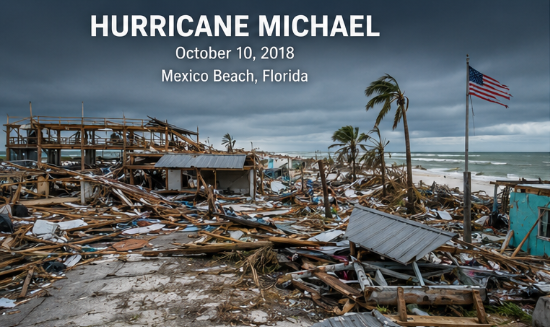
Hurricane Michael began as a tropical disturbance in the Caribbean before moving into the Gulf of Mexico in October 2018. As it encountered very warm ocean water and favorable atmospheric conditions, the storm strengthened rapidly, becoming a major hurricane and then a Category 5 hurricane shortly before reaching the Florida Panhandle. Michael made landfall near Mexico Beach, Florida, on October 10, 2018, with maximum sustained winds estimated at 160 mph, according to the National Hurricane Center’s post-storm analysis.
The intensity of Michael at landfall was extraordinary because the storm’s core struck the region with the strength of a Category 5 hurricane. Mexico Beach and nearby communities were subjected to extreme winds, storm surge and flying debris, while buildings that had survived previous storms were destroyed or severely damaged. Tyndall Air Force Base, located near the landfall area, also suffered catastrophic damage, demonstrating how a single hurricane can overwhelm even large and heavily engineered facilities.
One of the most frightening aspects of Michael was its rapid intensification before landfall. The storm strengthened dramatically while approaching the coast, leaving residents and emergency officials dealing with a hurricane that was becoming much more dangerous within a relatively short period. This is one of the reasons rapid intensification has become such an important issue in modern hurricane forecasting: when a storm strengthens quickly, the amount of preparation time available to communities can effectively shrink.
Michael continued inland after crossing Florida, bringing damaging winds and heavy rain into Georgia and other parts of the Southeast. Although the most catastrophic destruction occurred near the Florida Panhandle coast, the storm’s effects extended well beyond the point where its eye crossed the shoreline. According to the National Hurricane Center, Michael was directly responsible for 16 deaths in the United States and caused approximately $25 billion in damage at the time of the report.
HURRICANE IRMA: A GIANT ATLANTIC HURRICANE
Hurricane Irma developed in the tropical Atlantic in August 2017 and quickly became a major hurricane. It eventually reached Category 5 strength and became one of the most powerful Atlantic hurricanes ever recorded, with maximum sustained winds reaching approximately 185 mph. What made Irma particularly remarkable was not simply its peak wind speed but how long it remained extraordinarily powerful; the storm maintained maximum sustained winds of 185 mph for approximately 37 hours, an extraordinary duration for a hurricane of such intensity.
Irma also followed a much longer and more complicated path than Michael. Before reaching the United States, the hurricane devastated several Caribbean islands, including Barbuda, Saint Martin and the British and U.S. Virgin Islands, before moving toward Florida. By the time Irma reached the Florida Keys, it had weakened from its peak Category 5 intensity but remained an extremely dangerous Category 4 hurricane, and it later made another Florida landfall as a Category 3 hurricane.
The size of Irma was one of the storm’s defining characteristics. Its enormous circulation meant that destructive winds, storm surge and tropical-storm conditions affected a huge portion of Florida rather than being concentrated around one relatively small section of the coastline. The Florida Keys suffered particularly severe damage, while mainland Florida experienced widespread power outages, flooding, storm surge and structural damage as Irma moved northward.
Irma’s impact also extended beyond the immediate landfall zones. Large portions of Florida experienced dangerous weather conditions, and the storm continued into Georgia and other southeastern states after leaving the peninsula. Its enormous geographical footprint meant that the disaster involved millions of residents, businesses and infrastructure systems, which helps explain why its total economic impact was considerably greater than Michael’s.
HURRICANE MICHAEL VS. HURRICANE IRMA: WHICH WAS STRONGER?
If the question is simply which hurricane reached the greater maximum intensity, Irma was stronger. Irma reached maximum sustained winds of approximately 185 mph, while Michael reached approximately 160 mph at its Florida landfall. Both reached Category 5 strength, but Irma’s peak intensity was substantially higher.
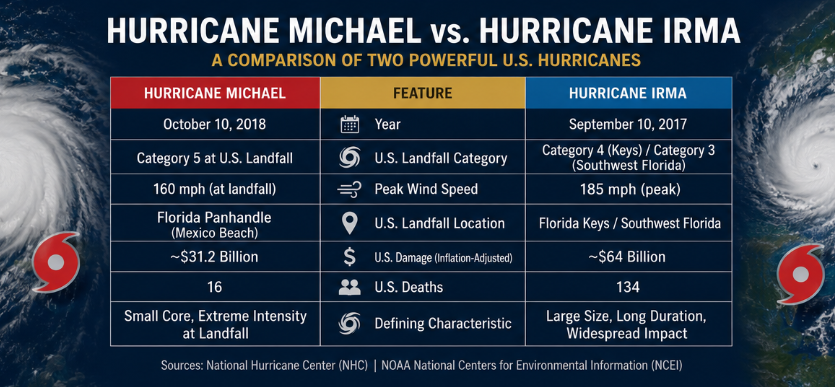
However, the comparison changes when the question becomes which hurricane was stronger when it struck the continental United States. Michael made landfall on the Florida Panhandle as a Category 5 hurricane with approximately 160 mph winds, making it one of the strongest hurricanes ever to strike the continental United States. Irma, despite reaching a higher peak intensity during its life, had weakened to Category 4 when it reached the Florida Keys and Category 3 when it made its second Florida landfall.
That distinction matters because a hurricane’s peak intensity and landfall intensity are not necessarily the same thing. A storm can reach Category 5 strength over the ocean and then weaken before reaching land, while another storm can intensify rapidly immediately before landfall. Michael is an excellent example of the second situation, and its catastrophic consequences demonstrated just how dangerous rapid intensification can become.
MICHAEL VS. IRMA: SIZE AND GEOGRAPHIC REACH
The difference in size between Michael and Irma helps explain why the two storms produced such different disasters. Michael was an exceptionally powerful hurricane, but its most extreme impacts were concentrated around the Florida Panhandle and parts of the southeastern United States. Irma, on the other hand, affected an enormous area before, during and after its passage through Florida.
Irma’s long track exposed multiple countries and U.S. states to hurricane conditions. The storm caused devastating damage in the Caribbean before reaching Florida, then moved through the Keys and across the Florida peninsula before continuing northward. Its broad wind field meant that communities could experience dangerous conditions even when they were not directly underneath the eye.
Michael’s impact was different because the storm’s most destructive core struck a relatively concentrated area. The communities near Mexico Beach and Panama City were exposed to some of the hurricane’s most extreme winds and storm surge, producing catastrophic structural damage. The contrast is useful because it demonstrates that a smaller, extremely intense hurricane can produce incredible destruction in a concentrated zone, while a larger hurricane can create a much broader regional disaster.
HURRICANE MICHAEL’S RAPID INTENSIFICATION
One of the most important stories behind Michael was how quickly it became a Category 5 hurricane. The storm entered the Gulf of Mexico as a system that was already strengthening, but the exceptionally warm waters and favorable atmospheric conditions allowed it to intensify dramatically as it approached Florida.
Rapid intensification is particularly dangerous because it can challenge traditional assumptions about how much time residents have to prepare. A community may be preparing for a tropical storm or Category 1 hurricane and suddenly find itself facing a much stronger system within a short period. Michael demonstrated why meteorologists increasingly emphasize not only a hurricane’s current category but also the possibility that its intensity could change rapidly before landfall.
This characteristic also helps explain why Michael’s destruction was so severe relative to its overall size. The storm delivered a concentrated burst of extreme energy into the Florida Panhandle, and the communities directly in its path had to withstand winds that were strong enough to destroy homes and infrastructure. In the areas closest to the eyewall, the difference between a major hurricane and a Category 5 hurricane was not merely a number on the Saffir-Simpson scale; it translated into dramatically different levels of structural destruction.
HURRICANE IRMA’S EXTRAORDINARY LONGEVITY
If Michael’s defining characteristic was rapid intensification, Irma’s defining characteristic was extraordinary longevity and sustained intensity. Irma became a Category 5 hurricane and maintained extreme strength for an unusually long period, reaching maximum sustained winds of about 185 mph and holding that intensity for roughly 37 hours.
That endurance made Irma particularly dangerous because it was not simply an extremely powerful storm for a few hours. It remained capable of producing catastrophic conditions over an extended period while traveling across the Caribbean. Several islands experienced devastating impacts before the storm even reached Florida, meaning the disaster had already become international in scale before the United States was directly affected.
Irma’s longevity also increased the logistical demands of disaster response. Governments, emergency services and residents had to deal with a storm that remained dangerous for days, while power companies, hospitals, airports, transportation networks and other critical systems prepared for prolonged disruption. The storm’s long duration made it a fundamentally different type of threat from Michael’s concentrated Florida Panhandle landfall.
STORM SURGE: A MAJOR THREAT FROM BOTH HURRICANES
Wind speed often receives the most attention when hurricanes are discussed, but storm surge can be equally or even more destructive. Storm surge occurs when hurricane winds push seawater toward the coast, causing water levels to rise above the normal astronomical tide and flooding low-lying coastal communities.
Michael produced devastating storm surge along the Florida Panhandle, particularly near its landfall area. The combination of extreme winds and rising seawater contributed significantly to the destruction along the coast, with water entering areas that were already vulnerable because of their low elevation and proximity to the Gulf of Mexico.
Irma also produced significant storm surge, particularly in the Florida Keys and along parts of the Florida coast. Because Irma was a much larger storm, its wind field extended across a much broader area, increasing the number of communities exposed to coastal flooding and surge. This is another example of how storm size can influence the overall damage footprint even when a hurricane is not making landfall at its absolute maximum intensity.
THE FLORIDA KEYS AND HURRICANE IRMA
The Florida Keys became one of the most recognizable symbols of Hurricane Irma’s destruction. The chain of low-lying islands is particularly vulnerable to storm surge because much of the land sits only slightly above sea level, while the surrounding ocean leaves communities exposed to powerful winds and rising water from multiple directions.
Irma caused extensive damage throughout the Keys, affecting homes, businesses, boats, vehicles, roads and utilities. NOAA reported that approximately 25% of buildings in the Florida Keys were destroyed and another 65% were significantly damaged, illustrating the enormous physical impact of the storm.
The Keys also faced an unusual recovery challenge because access is heavily dependent on a limited number of roads and bridges. When infrastructure is damaged, bringing supplies, emergency personnel and reconstruction equipment into the area becomes much more difficult. This meant that the effects of Irma continued long after the storm had moved away from Florida.
MEXICO BEACH AND HURRICANE MICHAEL
For Hurricane Michael, Mexico Beach became the community most closely associated with the storm’s destruction. The town was located close to where Michael’s eye crossed the coast, placing it directly in the path of the hurricane’s most intense winds and storm surge.
The resulting destruction was extraordinary. Homes were ripped apart, structures were severely damaged and debris was scattered over large areas, while the landscape around the community was transformed by the combination of wind and water. Images from the aftermath became some of the most powerful visual evidence of the destructive potential of a Category 5 hurricane.
The destruction at Mexico Beach also highlighted a fundamental principle of hurricane risk: distance from the center of the storm matters enormously. Communities near the eyewall can experience conditions dramatically more severe than locations only a relatively short distance away. Michael demonstrated this difference with unusual clarity because the most powerful part of the hurricane passed directly over communities along the Florida Panhandle.
WHICH HURRICANE CAUSED MORE DAMAGE?
When measured by total U.S. economic losses, Hurricane Irma was substantially more expensive than Hurricane Michael. NOAA’s inflation-adjusted disaster database places Irma’s U.S. damage at approximately $64 billion, compared with approximately $31.2 billion for Michael.
The difference does not mean Irma was twice as destructive in every location. Instead, it reflects the enormous geographical area exposed to Irma’s effects, the large population and infrastructure footprint involved, and the storm’s impacts across Florida and other parts of the southeastern United States.
Michael’s damage was concentrated more heavily in the Florida Panhandle. The destruction in that region was catastrophic, but the affected area was considerably smaller than the region exposed to Irma. In other words, Michael produced a more concentrated disaster, while Irma produced a much larger regional bill.
WHICH HURRICANE WAS DEADLIER?
The answer depends on whether we are discussing direct U.S. deaths, indirect deaths or the total human toll across all countries affected by each storm. Michael was directly responsible for 16 deaths in the United States according to the National Hurricane Center, while Irma’s overall death toll was significantly higher, reflecting the storm’s devastating impacts across the Caribbean and the United States.
Irma’s larger geographical footprint played an important role in its human impact. Several Caribbean islands suffered catastrophic destruction before the storm reached Florida, meaning that the hurricane had already caused extensive humanitarian consequences before it entered the United States.
Michael’s death toll in the United States was comparatively lower, but that should not obscure the severity of the storm. The hurricane struck a smaller population area with extraordinary intensity, and the communities closest to the landfall point experienced conditions that were among the most extreme ever recorded on the Florida Panhandle.
MICHAEL VS. IRMA: THE ECONOMIC COMPARISON
The numbers tell an important story. Irma’s inflation-adjusted U.S. damage was approximately $64 billion, compared with about $31.2 billion for Michael, making Irma more than twice as costly in the United States.
The difference reflects the scale of Irma’s impact rather than simply the strength of its winds. Irma affected a much larger geographical area, exposed a much larger population and infrastructure base, and caused extensive damage in Florida and elsewhere in the Southeast.
Michael’s damage was concentrated around the Florida Panhandle and neighboring states. The destruction near its landfall was extraordinarily severe, but the overall footprint was smaller.
WHAT MICHAEL TAUGHT US ABOUT HURRICANE RISK
Michael’s landfall changed the conversation about hurricane risk along the Florida Panhandle. The storm demonstrated that even areas that have not experienced a recent catastrophic hurricane can face extreme danger when conditions align for rapid intensification.
It also reinforced the importance of preparing for the worst credible forecast rather than assuming that a storm will remain at its current strength. When a hurricane is over exceptionally warm water and atmospheric conditions are favorable, its intensity can change quickly, and communities may have less time than expected to complete evacuations and secure property.
Most importantly, Michael demonstrated the destructive power of a Category 5 landfall. The storm was not simply another hurricane passing through Florida; it became one of the strongest hurricanes ever to strike the continental United States, leaving a lasting mark on the Florida Panhandle and surrounding communities.
WHAT IRMA TAUGHT US ABOUT HURRICANE RISK
Irma offered a different lesson. The storm showed that size and duration can be just as important as maximum wind speed, particularly when a hurricane affects a large and heavily populated region.
Florida’s geography made Irma especially challenging because the storm affected both coastal areas and inland communities. Residents across a huge portion of the state had to prepare for dangerous winds, storm surge, flooding and power outages, while emergency managers faced the enormous logistical challenge of protecting and assisting millions of people.
Irma also demonstrated that hurricane disasters do not end when the eye moves away. Power restoration, debris removal, rebuilding and economic recovery can take weeks, months or even years. For many communities, the most difficult part of a hurricane can begin after the television cameras have moved on.
HURRICANE MICHAEL VS. HURRICANE IRMA: THE FINAL VERDICT
If we judge by peak intensity, Hurricane Irma was stronger, reaching approximately 185 mph compared with Michael’s approximately 160 mph at U.S. landfall. Irma also maintained extreme intensity for an unusually long time, making it one of the most remarkable Atlantic hurricanes ever observed.
If we judge by U.S. landfall intensity, however, Hurricane Michael takes the distinction. Michael struck the Florida Panhandle as a Category 5 hurricane, delivering its maximum force directly to the continental United States. Irma reached Florida after weakening from its peak, making landfall in the Keys as a Category 4 and later striking southwestern Florida as a Category 3.
If we judge by economic damage, Irma was considerably more expensive. NOAA’s inflation-adjusted estimates put Irma at approximately $64 billion in U.S. damage, compared with about $31.2 billion for Michael.
And if we judge by geographical reach, Irma clearly stands apart. Its impacts stretched across the Caribbean, Florida and the southeastern United States, exposing a vast population and enormous amount of infrastructure to dangerous conditions.
Michael, meanwhile, will be remembered for something different: the terrifying concentration of extreme hurricane power that struck the Florida Panhandle in October 2018.
CONCLUSION
Hurricane Michael and Hurricane Irma were both Category 5 hurricanes, but treating them as essentially the same type of storm would miss the most important part of their stories. Irma was larger, longer-lived and stronger at its peak, affecting an enormous area and producing approximately twice the inflation-adjusted U.S. economic damage of Michael. Michael, however, became an exceptionally dangerous storm immediately before landfall and struck the Florida Panhandle as a Category 5 hurricane, producing catastrophic destruction in communities near its path.
Together, the two hurricanes demonstrate why hurricane categories should never be used as the only measure of danger. Wind speed tells us how strong the hurricane is, but it does not tell us how large the storm will become, how much water it will push toward the coast, how quickly it will intensify, how much rainfall it will produce or how many people and buildings will be exposed.
The most important lesson from Michael and Irma is therefore not simply which storm was stronger. It is that different hurricanes create different kinds of disasters. Michael was a concentrated display of extreme wind and storm surge, while Irma was a sprawling and long-lasting threat that affected a much larger geographical area.
For Florida and the wider southeastern United States, both storms remain important reminders of the region’s vulnerability. The next major hurricane may not behave like Michael or Irma at all, which is precisely why preparation must account for more than a storm’s category. The history of these two hurricanes shows that when the right atmospheric and oceanic conditions come together, a hurricane can change rapidly and leave consequences that last long after the winds have disappeared.